Choosing solar for an RV begins with measured energy use, not a guessed panel number. The practical question is “how to calculate solar panel capacity for rv” under real travel conditions. An RV refrigerator, LED lights, water pump, roof fan, inverter, and laptop can create very different daily loads. Record each appliance’s wattage, operating hours, and battery voltage for several days. Small details matter. A fan running overnight can quietly consume more energy than expected.
A dependable estimate uses this formula: daily watt-hours ÷ usable peak-sun hours ÷ system derating. The National Renewable Energy Laboratory’s PVWatts tool provides location-based solar production estimates, including tilt, azimuth, weather, and system losses. Its modeling approach is more realistic than multiplying panel wattage by daylight hours. The U.S. Department of Energy also notes that module output varies with temperature, shading, orientation, and efficiency. That matters on an RV roof, where air conditioners, roof vents, and satellite equipment can cast partial shadows.
For example, a camper using 1,200 watt-hours daily, receiving four peak-sun hours, and allowing 25% losses needs about 400 watts of solar capacity. Add reserve capacity for cloudy weather and imperfect parking. I would not treat this result as exact. Real trips expose weak assumptions. A 500-watt array may suit moderate use, while heavy inverter loads require more panels, larger batteries, or both. The IEA PVPS Trends report confirms solar deployment is expanding rapidly, yet RV systems remain highly site-dependent. This guide connects professional modeling with practical campsite measurements, helping readers choose a safer, more reliable design.
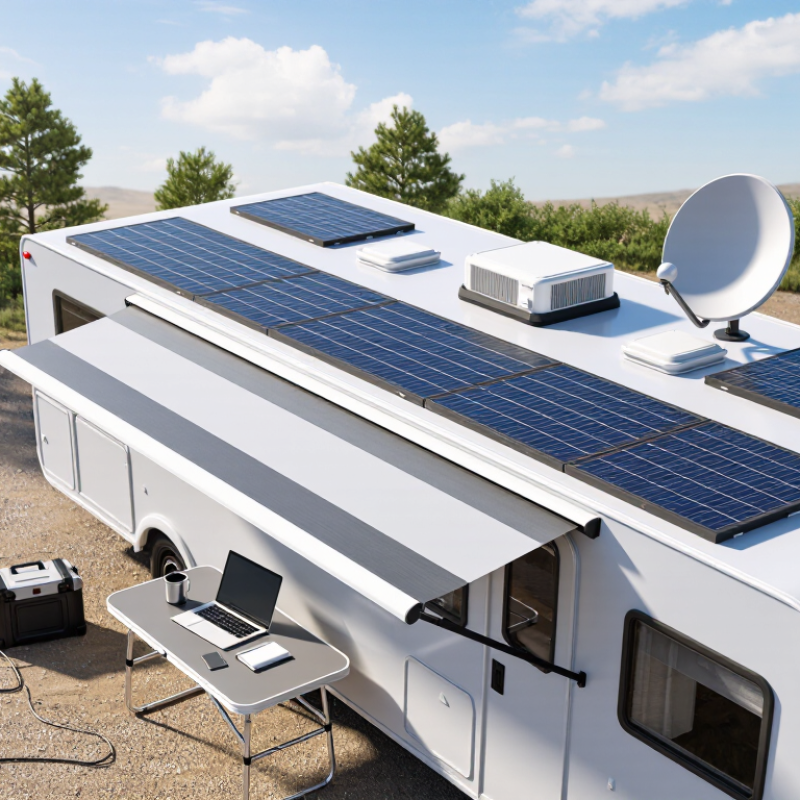
Define Your RV’s Daily Energy Consumption
How to Calculate Solar Panel Capacity for an RV?
Define Your RV’s Daily Energy Consumption
Start with a simple load audit. List every appliance, its wattage, and daily runtime. Then multiply watts by hours to estimate watt-hours.
For example, a 45-watt refrigerator running for ten hours uses 450 Wh.
A 35-watt ventilation fan running for six hours adds 210 Wh.
Eight-watt lights used for four hours consume only 32 Wh.
Add water-pump use, device charging, and inverter standby demand.
A realistic sample load reaches about 820 Wh daily. Add a 20% reserve for cold weather, aging batteries, and overlooked loads. That creates a target near 985 Wh per day.
The U.S. Department of Energy reports that LED bulbs use at least 75% less energy than incandescent bulbs. Small choices matter inside a compact RV. The NREL PVWatts documentation uses a 14% default system-loss assumption, including wiring and inverter losses. Treat that figure as a planning reference, not a promise.
Tips:
Measure real consumption with a plug-in meter or battery monitor for three days. Record refrigerator cycling, especially overnight. Some estimates will be wrong. That is useful. Correct them before sizing panels. Also separate daytime loads from nighttime loads. Solar panels may cover daytime use directly, while batteries must support evening demand. A cloudy campsite can expose an overly optimistic calculation.
Identify Available Sunlight and Solar Charging Conditions
Before sizing an RV array, measure the sunlight available at the parking spot, not the panel’s nameplate rating. An open campsite may receive six usable peak-sun hours, while a shaded forest site may receive far fewer. Use monthly data from the World Bank–ESMAP Global Solar Atlas and compare it with NREL’s National Solar Radiation Database. These resources use long-term satellite and weather observations, but local trees can still invalidate an attractive map. Watch the roof from 9 a.m. to 3 p.m. Roof vents, air conditioners, and nearby branches can cast narrow shadows that reduce output sharply. Record the shortest winter day, because summer averages can produce an overconfident design.
Panel ratings use standard test conditions: 1,000 watts per square meter, 25°C cell temperature, and a defined spectrum. An RV roof rarely stays there. Heat, dust, cable losses, controller limits, battery acceptance, and partial shade all reduce charging energy. NREL’s PVWatts model applies a default 14% total system-loss assumption in many baseline estimates. That figure is useful, not sacred. For example, a 400-watt array receiving four peak-sun hours yields 1.6 kilowatt-hours before losses. After the 14% baseline loss, expect about 1.38 kilowatt-hours, before battery and charging limits. Cloud edges, snow, or a badly tilted roof can lower it further. I once treated a clear forecast as reliable; morning fog proved otherwise. Recheck actual controller data across several trips.
Calculate the Required Solar Panel Wattage
To calculate solar panel wattage for an RV, estimate your daily energy use in watt-hours. List every device, including lights, fans, water pumps, refrigerators, and laptops. Multiply each device’s wattage by its daily operating hours. Then add the results. For example, a 60-watt fan running for five hours uses 300 watt-hours. Keep standby consumption in mind. Small losses add up.
Use this practical formula: required panel watts = daily watt-hours ÷ peak sun hours ÷ system efficiency. Suppose your RV uses 1,200 watt-hours daily. With 4.5 peak sun hours and 80% system efficiency, the calculation is 1,200 ÷ 4.5 ÷ 0.8, or about 333 watts. A 350-watt array may work in clear summer weather. I would choose around 400 watts for extra margin.
Weather changes the result. Shade, dust, low winter sunlight, and panel angle can reduce production sharply. Leave room for cloudy days. Adding 25% to 40% capacity can make daily charging more dependable. Your battery should also store enough energy overnight. Do not size panels from appliance labels alone. Real use is often different. I have found that people underestimate cooking devices and inverter losses. Record your actual consumption for several days, then revise the estimate before installation. A watt meter can reveal surprising loads. Mistakes happen. Recheck the numbers.
Match Panel Capacity with Battery and Charge Controller Ratings
How to Calculate Solar Panel Capacity for an RV?
Match Panel Capacity with Battery and Charge Controller Ratings
A practical estimate starts with the battery, not the roof. A 12-volt, 200Ah battery stores about 2,400 watt-hours. However, usable energy depends on battery chemistry and its recommended discharge limit. If only half is usable, the working capacity is about 1,200 watt-hours. That number matters.
Suppose your RV uses 900 watt-hours daily. A 300-watt solar array may produce 900 watt-hours after four peak-sun hours and system losses. Real conditions are messier. Heat, shade, dust, and low winter sun reduce output. I would usually add a 20–30% capacity margin. My first estimate was often too optimistic. Weather corrected it.
The charge controller must safely handle the array’s power and voltage. With a 300-watt array charging a 12-volt battery, output current can approach 25 amps. A controller rated for at least 30 amps gives useful breathing room. Check its maximum photovoltaic voltage, especially when panels connect in series. Cold mornings can raise open-circuit voltage beyond the panel label. The controller must also support the battery’s charging profile. A larger array is not automatically better. Excess power can exceed controller limits, overload wiring, or leave energy unused. Confirm fuse sizes, cable ratings, and battery-terminal voltage with a qualified technician before installation.
How to Calculate Solar Panel Capacity for an RV?
Match panel capacity with battery storage and charge controller ratings
Estimates assume an 80% usable battery capacity, 4 peak-sun hours per day, and 75% total charging efficiency.
Recommended panel capacity is rounded upward. The controller ceiling is an approximate photovoltaic input limit
calculated from the controller charging-current rating and battery charging voltage. Actual results vary with shading,
temperature, season, wiring losses, and controller specifications.
Adjust the Solar System for Weather, Season, and Future Power Needs
How to Calculate Solar Panel Capacity for an RV?
Start with your real daily energy use, not a perfect-weather guess. List the refrigerator, lights, water pump, fan, electronics, and charging devices. Multiply each device’s watts by its daily operating hours. For example, an RV using 1,200 watt-hours daily needs about 375 watts of solar with four peak sun hours and 80% system efficiency. In practice, I would choose 450 to 500 watts. Losses come from wiring, heat, panel angle, dust, and the charge controller.
Weather and season can change the result sharply. Summer sunlight may support strong production, while winter brings shorter days and a lower sun angle. Cloudy days can reduce output dramatically. Add a 25% to 40% reserve for unsettled weather. In shaded campsites, the reserve may need to be larger. Panels should also be tilted when practical, because a flat roof rarely captures maximum sunlight.
Plan for tomorrow’s power use, too. A small inverter, laptop, medical device, or extra fan can raise demand quickly. My first estimate was too optimistic because I ignored morning heating and battery losses. That mistake taught me to track actual consumption for several trips. Check the battery’s usable capacity, controller rating, and cable size before expanding the array. Solar production is never perfectly predictable. Leave room for correction.
How to Calculate Solar Panel Capacity for an RV? - Adjust the Solar System for Weather, Season, and Future Power Needs
| RV Daily Energy Consumption Estimate |
| Load |
Quantity |
Power per Unit (W) |
Use per Day (Hours) |
Daily Energy (Wh) |
System Type |
Calculation Note |
| Compressor Refrigerator |
1 |
60 |
8 |
480 |
DC |
Average compressor runtime; actual use varies with ambient temperature. |
| LED Interior Lights |
5 |
4 |
4 |
80 |
DC |
Five low-power lights used during evening hours. |
| Ventilation Fan |
1 |
35 |
6 |
210 |
DC |
Continuous or intermittent ventilation depending on weather. |
| Water Pump |
1 |
60 |
0.5 |
30 |
DC |
Typical total pump runtime for sinks and shower use. |
| Laptop Computer |
1 |
60 |
3 |
180 |
AC |
Includes inverter losses when powered from a DC battery. |
| Mobile Device Charging |
2 |
10 |
2 |
40 |
DC/USB |
Two phones or similar small electronic devices. |
| Television |
1 |
50 |
2 |
100 |
AC |
Estimated consumption through an inverter. |
| Miscellaneous Loads |
1 |
50 |
3 |
150 |
DC/AC |
Small appliances, standby consumption, and occasional loads. |
| Estimated Daily Load |
1,270 Wh |
Before charging and inverter losses |
| Design Energy After 15% System Losses |
1,494 Wh |
Recommended design baseline |
| Solar Capacity Adjustment for Sunlight, Weather, Season, and Future Needs |
| Design Condition |
Peak Sun Hours per Day |
Weather Factor |
Future Load Allowance |
Required Solar Capacity |
Practical Panel Array |
Battery Storage at 12 V |
Recommended Use |
| Clear Summer Conditions |
5.5 |
0.85 |
10% |
≈350 W |
400 W |
150–200 Ah |
Suitable for efficient use in sunny regions. |
| Spring or Autumn Conditions |
4.0 |
0.80 |
15% |
≈540 W |
600 W |
200 Ah |
Balanced option for variable sunlight and moderate travel. |
| Cloudy Winter Conditions |
2.5 |
0.70 |
20% |
≈1,020 W |
1,000–1,200 W |
300–400 Ah |
Better for short winter days, shading, and frequent overcast weather. |
| Recommended All-Season Design |
3.5 |
0.75 |
20% |
≈800 W |
800–900 W |
250–300 Ah |
Practical starting point for changing weather and future expansion. |
Calculation method: Required solar capacity = Daily energy demand × future-load allowance ÷ (peak sun hours × weather factor). Actual results depend on location, roof shading, panel angle, temperature, battery efficiency, and personal usage.
FAQS
List each appliance, its wattage, and daily runtime. Multiply watts by hours to calculate watt-hours. Include standby demand.
A 45-watt refrigerator running ten hours uses 450 watt-hours. A 35-watt fan running six hours uses 210 watt-hours. Eight-watt lights used four hours consume 32 watt-hours.
Yes. Add about 20% for cold weather, aging batteries, and forgotten loads. A 820-watt-hour estimate becomes roughly 985 watt-hours.
An RV using 1,200 watt-hours daily may need about 375 watts of solar. That assumes four peak sun hours and 80% system efficiency. In practice, 450 to 500 watts may be safer.
Heat, dust, wiring, panel angle, and controller losses reduce production. A flat roof rarely captures maximum sunlight. Clouds change everything.
Add a 25% to 40% reserve for unstable weather. Shaded campsites may require more capacity. Winter sunlight is shorter and weaker.
Use a plug-in meter or battery monitor for three days. Record refrigerator cycling, overnight use, charging devices, and inverter standby demand. Measure it.
Yes. Solar can support daytime appliances directly. Batteries must cover evening demand. Check usable battery capacity before expanding the array.
I once ignored morning heating and battery losses. My estimate was too optimistic. Track actual use across several trips, because assumptions often fail.
Conclusion
Learning how to calculate solar panel capacity for RV use starts with estimating your daily energy consumption. List the power needs of appliances, lights, electronics, and other devices, then convert their usage into watt-hours per day. Next, evaluate the sunlight available at your typical travel locations, considering usable daylight, shade, panel positioning, and charging losses. These factors help determine how much solar energy your system can realistically produce.
To calculate the required panel wattage, divide your daily energy needs by the expected effective sunlight hours and add a reasonable allowance for system inefficiency. The result should be compared with your battery’s storage capacity and the charge controller’s voltage and current limits to ensure safe, balanced operation. Finally, adjust the system for seasonal changes, cloudy weather, and future energy demands. A slightly larger capacity can provide greater reliability and reduce the need for frequent supplemental charging.

 ConTech Solar